


Toronto is going to win Friday night, and it still won’t have fixed a thing. Gavin McKenna is the best player in this draft, the kind of playmaker a franchise builds a decade around. None of that changes why the Maple Leafs keep going home in the spring.
That tension is the whole story of this pick. The lottery handed Toronto a generational talent and a wave of relief after a brutal stretch, and the temptation now is to treat Friday as the answer. It isn’t. It’s the easy part of a summer that gets a lot harder once the new front office is off the clock.
Taking McKenna Is the Easiest Call Toronto Will Make All Summer
Let’s be clear about the pick itself, because this is not a column arguing Toronto should outsmart the room. McKenna is the No. 1 skater in NHL Central Scouting’s final ranking, and he earned it: 51 points in 35 games as an 18-year-old at Penn State, 15 goals and 36 assists, with a team-high 152 shots, per NHL.com. Scouts keep reaching for the same comparable, a slippery, deceptive playmaker who slows the game down and finds seams before anyone else sees them.
When the best player in a draft is this clear, you take him. Drafting for “need” at No. 1, reaching for a right-shot defenseman because the big club has a hole, is how teams turn a franchise pick into a cautionary tale. So this is not a plea to trade down or get cute. Toronto should walk to the podium and call McKenna’s name without a second thought.
The problem is what happens next, when the confetti settles and the actual roster is still sitting there.
The Leafs Don’t Lose in the Spring Because They Lack Skill
Here is the uncomfortable part for a fan base that just got handed a gift. Toronto’s playoff exits have never been a talent problem at the top of the lineup. This is a team that has run Auston Matthews, William Nylander, and, until this summer, Mitch Marner through the most skilled top six in hockey, and still couldn’t get over the hump.
What sank them, year after year, was everything underneath the stars: a soft middle, a third line that disappeared when the checking tightened, a blue line that couldn’t move the puck cleanly under forecheck pressure. Those are the gaps that decide a tied game in late May. And a brilliant teenage left winger does nothing for any of them.
McKenna is more of the thing Toronto already has too much of, and none of the thing it keeps losing without.
That’s not a knock on him. It’s a description of the roster he’s walking into.
An 18-Year-Old Winger Doesn’t Move the 2026-27 Needle
Strip away the draft-night euphoria and ask the cold question: how much better does McKenna make next year’s team? Honestly, barely at all. First-year wingers, even great ones, are usually treading water defensively while their offense catches up to the speed of the league. The realistic version of McKenna’s rookie season is flashes, growing pains, and sheltered minutes, not a 70-point season that drags Toronto past Florida.
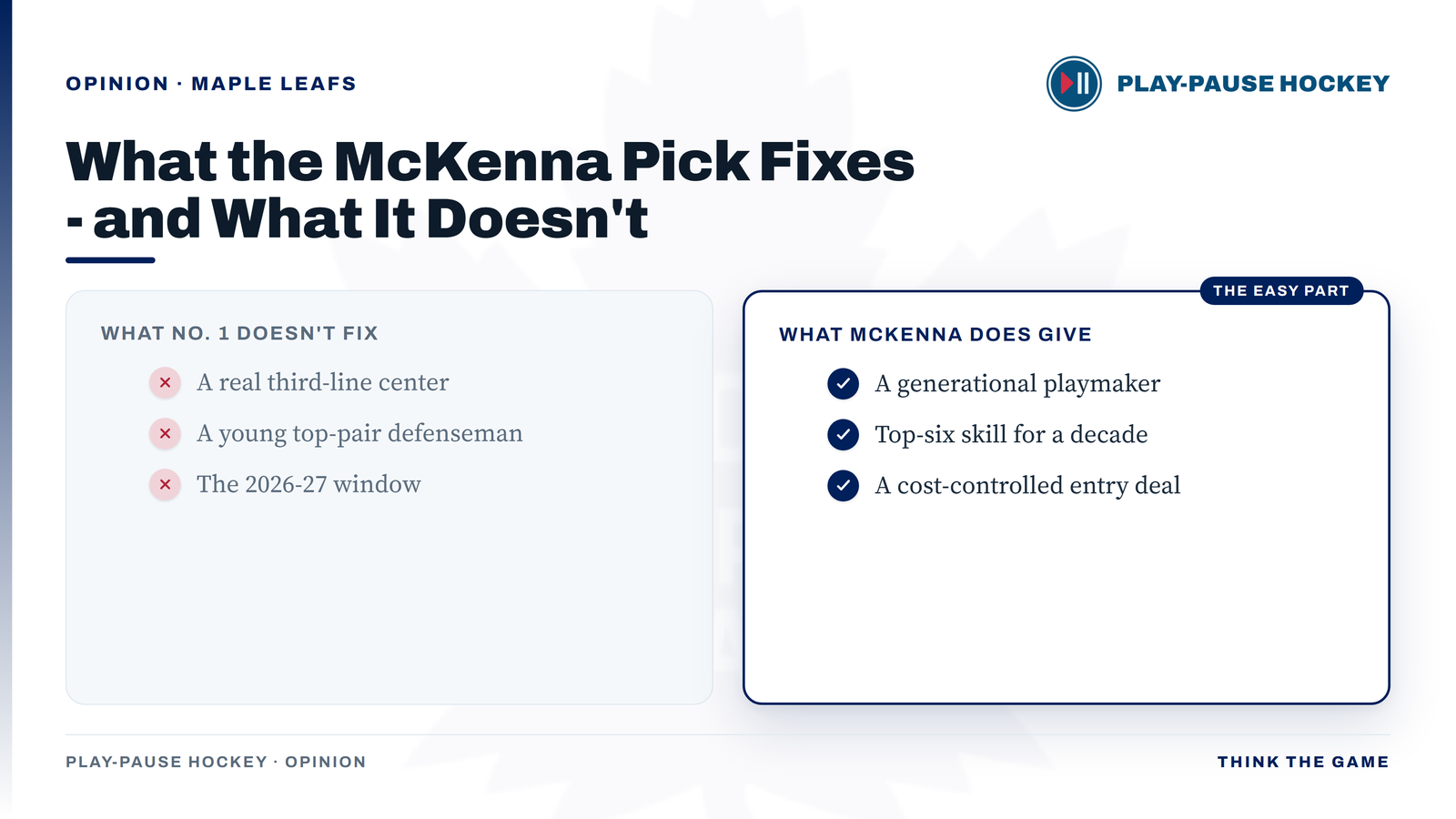
Meanwhile the holes the team actually needs to plug, a real third-line center behind a 36-year-old John Tavares, a young defenseman who can play top-pair minutes, are exactly the kind of pieces an entry-level winger can’t fill. McKenna is a long-term asset arriving to answer a short-term question, and the two simply don’t match.
McKenna’s Clock and the Matthews Window Don’t Line Up
This is the part Toronto can’t wish away. The McKenna timeline and the Matthews timeline are pulling in opposite directions. McKenna’s real impact, the version where he’s a top-line driver who tilts playoff series, probably arrives around 2028. Matthews, the engine the whole operation is built on, is in his prime right now.
Matthews scored 27 goals in just 60 games before a Grade 3 MCL tear and quad contusion ended his regular season early, per reporting on Toronto's roster. He turns 29 this fall, with the most dangerous years of his career happening now, not in 2028.
By the time McKenna is ready to swing a series, the player Toronto most needs to win for will be on the wrong side of 30. That’s not an argument against drafting him. It’s an argument that the pick and the contention window are aimed at two different seasons, and only one of them, Chayka’s summer of trades and signings, can do anything about the one that’s open today.
The Real Test Starts the Moment Chayka Is Off the Clock
So here’s the honest read on Toronto’s biggest night of the offseason: the easy part is the headline, and the hard part is everything after it. John Chayka, in his first summer running the show, cleared roughly $27 million in space, in part by shedding Joseph Woll’s $3.6 million and another contract in a June 16 trade with Philadelphia, and walks into free agency with five roster spots to fill, per Puckpedia. That money, and what he does with it, is the actual story of this offseason.
Find a third-line center who can win a defensive-zone draw in June. Add a defenseman under 25 who can log 22 minutes against the other team’s best. Resist the urge to treat McKenna’s arrival as permission to stand pat. Do that, and Friday’s pick becomes the cherry on a real summer. Skip it, and Toronto will have the best 18-year-old in hockey and the exact same ceiling it had in April.
Take McKenna. Celebrate him. Then get to work, because the pick was never the problem the Maple Leafs needed to solve.